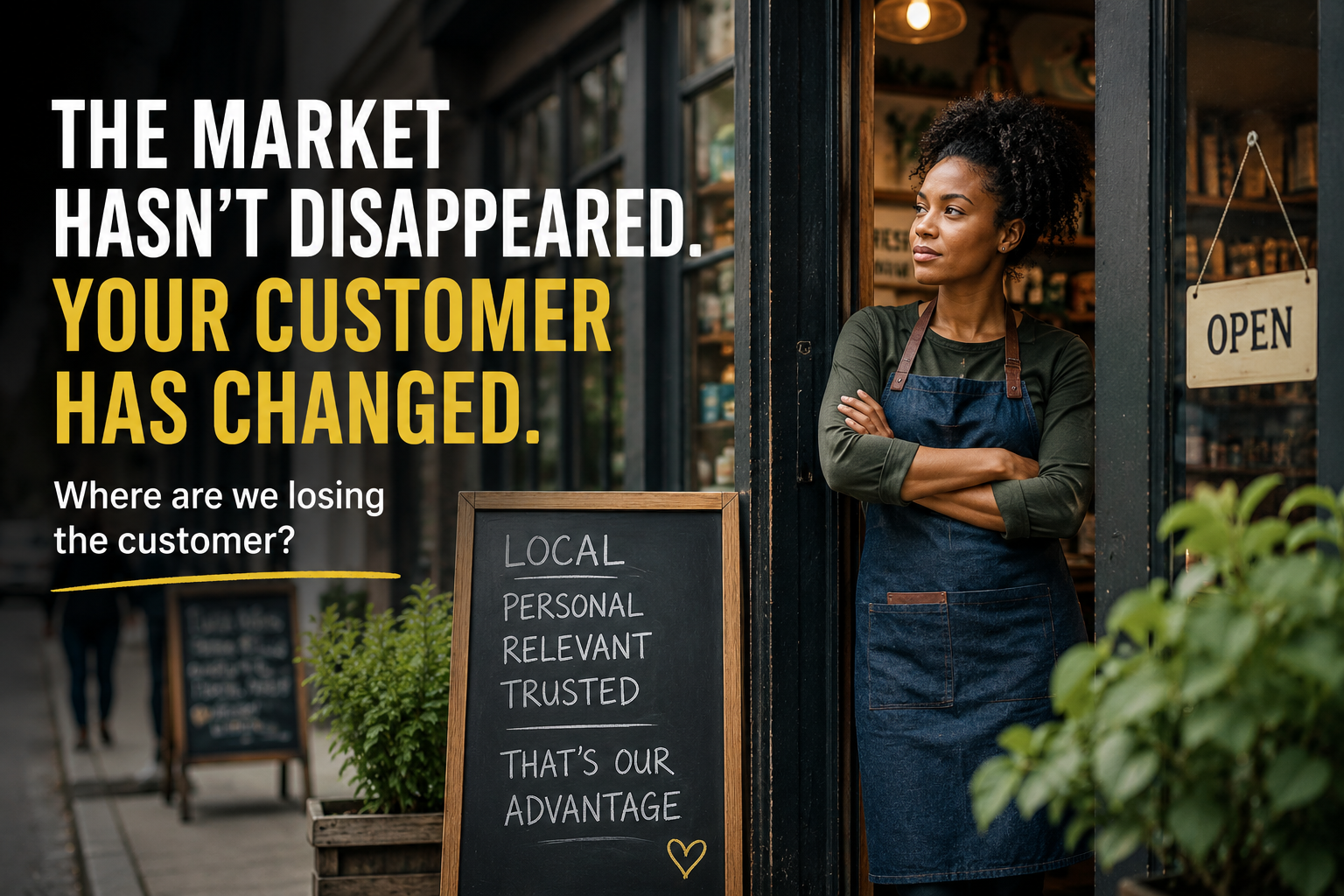
South African business owners are feeling it.
Customers are taking longer to make decisions. Quotes aren’t converting as quickly. People are asking more questions about price. Operating costs remain high. And businesses that were comfortably ticking along a few years ago are suddenly asking:
Where has everybody gone?
The temptation is to blame the economy.
And yes, the economy matters.
South African households are under pressure. Fuel and transport costs have increased. Consumer confidence has weakened. Small businesses are dealing with tighter margins while their customers are becoming increasingly careful about where they spend their money.
But here’s the part we think businesses need to pay attention to:
People haven’t stopped spending. They’ve become more selective about who they spend their hard-earned money with.
And that changes the marketing conversation completely.
Look at what the big retailers are doing
Shoprite and Checkers aren’t succeeding simply because they’re big.
Scale certainly helps.
But look more closely at what they’ve built around the customer.
Convenience.
Value.
Speed.
Digital accessibility.
A frictionless purchasing experience.
Checkers Sixty60 didn’t simply advertise groceries differently. It changed the experience of buying them.
That’s an important distinction.
Because marketing isn’t only about getting someone’s attention.
It’s about making it easier for them to choose you.
Small businesses cannot out-Shoprite Shoprite
Nor should they try.
An independent retailer, restaurant, professional service provider, manufacturer, or family business isn’t going to compete with a national group on buying power, technology budgets, or distribution networks.
But small businesses have advantages that large corporations spend millions trying to recreate.
Personality.
Relationships.
Specialist knowledge.
Agility.
Local understanding.
The ability to genuinely know their customers.
The problem is that many businesses aren’t marketing those advantages.
They’re posting products.
They’re posting specials.
They’re posting motivational quotes.
They’re telling people what they sell.
Meanwhile, the customer is quietly asking:
Why should I spend my limited money with you?
That’s the question marketing needs to answer.
Before blaming your marketing, get curious
This is a conversation we’re increasingly having with businesses.
Someone says:
“We’re not getting enough leads.”
Our first question shouldn’t necessarily be:
“How many times are you posting on Facebook?”
We need to go deeper.
How many inquiries did you receive?
How many quote requests?
How many quotes did you send?
How many became paying customers?
Where did the others disappear?
Did they think you were too expensive?
Did somebody respond too slowly?
Was your offer unclear?
Did they understand why you’re different?
Did they trust you?
Did someone else simply make it easier to buy?
There is often a gap between marketing and the sale.
And posting three more times on Instagram won’t automatically fix it.
Marketing in a squeezed economy has to work harder
When customers have money to spare, businesses can sometimes get away with mediocre marketing.
When wallets tighten, clarity matters.
Your customer needs to understand:
What problem do you solve?
Why are you worth the money?
Why should they trust you?
What makes you different?
And what should they do next?
This is where small businesses need to stop thinking about marketing purely in terms of “content”.
Sometimes the answer is social media.
Sometimes it’s your website.
Sometimes it’s a better follow-up process.
Sometimes it’s changing your offer.
Sometimes it’s improving the customer experience.
Sometimes it’s realizing you’re generating plenty of inquiries…you’re simply not converting them.
Don't automatically discount. Create value.
One of the biggest dangers in a difficult economy is racing straight towards cheaper.
Discount.
Special.
Sale.
Another discount.
Eventually you’re training your customers to wait until you reduce the price.
Instead, ask:
How can we make this feel more valuable?
Bundle complementary services.
Make ordering easier.
Reward repeat customers.
Educate customers before they buy.
Show your expertise.
Explain the difference between cheap and good value.
Follow up properly.
Give people reasons to come back.
And most importantly, talk to your customers.
Small businesses have something incredibly valuable available to them that big organisations often struggle to achieve:
Proximity to the customer.
Use it.
Your next marketing meeting needs different questions
Don’t begin with:
“What are we posting next month?”
Begin with:
What is happening in our business?
What are customers asking for?
What are they worried about?
What objections are we hearing?
Which products or services are growing?
What isn’t selling?
Where are inquiries dropping off?
What are our best customers repeatedly buying from us?
What are competitors doing that customers clearly value?
Then build the marketing around the answers.
Because right now, South African businesses don’t need more noise.
They need relevance.
They need differentiation.
They need to better understand their customers.
And they need marketing that connects the business’s goals with what the customer actually needs.
That’s where growth can AND WILL still happen… even in a squeezed economy.
Word on the Street Media
We don’t create content for the sake of creating content. We solve business problems.
Sometimes the solution is social media.
Sometimes it’s a website.
Sometimes it’s an event.
Sometimes it’s changing the message completely.
The tool changes. The strategy doesn’t.