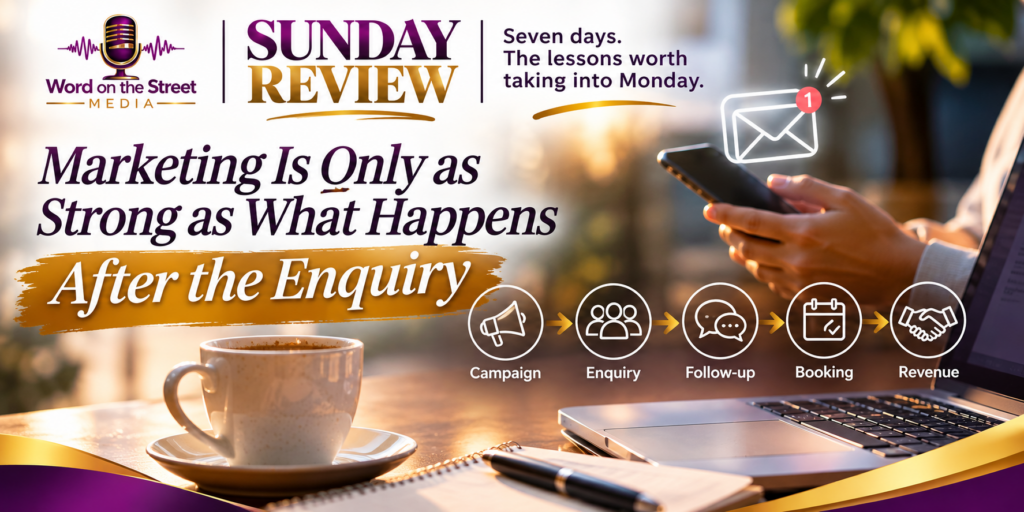
Seven days. The lessons worth taking into Monday.
One of the easiest moments to celebrate in marketing is the enquiry.
The message comes in.
The form is completed.
Someone asks for a quote.
A customer phones.
A booking request lands.
And we think:
Great. The marketing worked.
But this week reminded us of something important:
An enquiry is not the result.
It is the opportunity.
What happens next determines whether that opportunity becomes revenue.
That distinction matters because businesses often spend enormous amounts of time, money and energy trying to generate more leads while paying far less attention to what happens to the leads they already have.
And sometimes the marketing is not the problem at all.
The problem is what happens after it.
1. A lead is not a sale
Generating interest is only the first part of the journey.
A lead can arrive and disappear almost immediately if nobody is ready for it.
How quickly does somebody respond?
Does the customer receive the information they asked for?
Is the next step obvious?
Does anybody follow up?
Is the outcome recorded?
A campaign can generate plenty of leads and still produce disappointing commercial results.
That does not automatically mean the campaign failed.
The business may have a conversion problem rather than a lead-generation problem.
Those are two very different things.
Before spending more money generating leads, it is worth asking:
What percentage of the enquiries we already receive actually become business?
2. Marketing and operations are no longer separate conversations
Marketing may bring the customer to the door.
But everything that happens afterwards continues to shape their impression of the brand.
The website.
The WhatsApp conversation.
The quotation.
The booking system.
The payment process.
The confirmation email.
The delivery.
The follow-up.
From inside a business, these activities may belong to different departments or people.
The customer does not see those divisions.
They experience one business.
If the advertisement says:
“Easy booking.”
but the customer struggles to book, that is a marketing problem too.
If the campaign promises exceptional service but a message sits unanswered for two days, the brand promise has already been weakened.
The customer journey does not stop when someone clicks.
3. Response time matters more than many businesses realise
Customers usually enquire at a moment when their interest is high.
That moment does not last forever.
They compare.
They keep searching.
They ask another supplier.
Something else distracts them.
The business that responds quickly does not automatically win the customer, but it removes one significant piece of friction.
This does not mean every business needs to be available 24 hours a day.
It means there should be a clear process.
Who responds?
How quickly?
What happens if the person responsible is unavailable?
What information should the customer receive immediately?
What happens next?
Response time should not be treated purely as administration.
It is part of the customer experience.
And customer experience is part of marketing.
4. The agency cannot close every loop for the client
This is an important part of the agency-client relationship.
A marketing agency can:
Develop the strategy.
Create campaigns.
Build awareness.
Produce content.
Generate leads.
Support the sales process.
Analyse performance.
But the business itself still has responsibilities.
It needs to provide accurate information.
Approve work.
Respond to enquiries.
Prepare quotations.
Follow up.
Deliver the service.
And tell the agency what happened to the leads.
Without that information, marketers can see that somebody clicked.
They can see that somebody enquired.
But they cannot tell whether the enquiry produced revenue.
That makes meaningful optimisation difficult.
Marketing works best when the agency and client treat conversion as a shared commercial responsibility.
5. Clarity makes it easier to say yes
Sometimes businesses assume they need more persuasive marketing.
What they actually need is more clarity.
Can the customer understand the offer quickly?
Who is it for?
What is included?
How does the process work?
What happens next?
How do they get started?
How is pricing handled?
Who do they contact?
Every unanswered question introduces a little more hesitation.
And hesitation creates an opportunity for the customer to leave.
This is why packaging services clearly can be so effective.
It does not necessarily make the product cheaper or more promotional.
It simply makes the decision easier to understand.
Confusion creates friction. Clarity reduces it.
6. Follow-up is not pestering
Many businesses are uncomfortable following up.
They fear annoying the customer.
But there is a significant difference between aggressive chasing and useful follow-up.
People get busy.
Emails disappear down inboxes.
Messages get read during meetings and forgotten.
Quotes are opened and left for later.
A polite follow-up can simply say:
“Do you need anything else from us to make a decision?”
That is service.
Not pressure.
And if a customer decides not to proceed, that information is useful too.
Why?
Price?
Timing?
Competitor?
Changed circumstances?
Unclear offer?
Every lost opportunity can potentially teach the business something.
But only if somebody follows up.
7. Measure what happens after the enquiry
Marketing reporting often focuses heavily on the top of the funnel:
Reach.
Impressions.
Engagement.
Clicks.
Website traffic.
Leads.
All of these metrics can be useful.
But they tell only part of the story.
Businesses should also understand:
How many leads were genuine?
How many were contacted?
How many received quotations?
How many became provisional bookings?
How many converted?
What was the revenue?
What was the average value?
Where did people drop out?
That is where marketing starts connecting directly with business performance.
Without this information, a company can easily make the wrong decision.
It may cut a campaign that is generating excellent leads because sales are low.
Or continue spending on a campaign generating poor-quality enquiries because the lead count looks impressive.
More leads is not always the answer.
Sometimes better conversion is.
8. Make the next step obvious
There is a simple question every piece of marketing should answer:
What should the customer do next?
Call?
WhatsApp?
Book?
Request a quote?
Schedule a consultation?
Visit?
Order?
Reply?
A good call to action does not have to be aggressive.
It simply gives the customer direction.
The easier the next step feels, the less friction sits between interest and action.
This applies beyond advertising too.
Think about the entire journey.
After the enquiry, what happens next?
After the quote?
After the provisional booking?
After the meeting?
After the purchase?
A strong customer journey keeps answering that question.
The question we’re taking into Monday
Businesses frequently ask:
“Is our marketing working?”
It is the right question.
But it is no longer enough on its own.
We also need to ask:
“Is the business ready for the marketing to work?”
Because demand without follow-through is wasted opportunity.
Marketing cannot answer an unanswered WhatsApp message.
A lead cannot follow itself up.
An advertisement cannot simplify a complicated booking system.
A campaign cannot tell us whether the sale closed if nobody records the outcome.
Marketing can create the opportunity.
The business still needs to convert it.
So before investing in the next campaign, perhaps spend a little time looking at what happens to the customer who responds to the campaign you already have.
You may discover that the next growth opportunity is not at the top of the funnel at all.
It may be sitting quietly somewhere between:
“I’m interested.”
and
“Yes, let’s go ahead.”
And that is the lesson we’re taking into Monday.
Sunday Review
Seven days. The lessons worth taking into Monday.
Word on the Street Media
We don’t create content. We solve business problems.